What is a Nursing Associate (NA) and when was the role introduced?
In 2015, the UK Government created the Nursing Associate (NA) role in response to findings identified in the “Shape of Caring: Raising the Bar” review (Health Education England, 2015). The main aim of this role creation was to:
To fill the capability gap between Healthcare Assistants and Registered Nurses.
Offer formal career progression.
Reduce workforce shortages.
The first training programmes started in 2017, and the role is now embedded within many nursing teams.
Nursing Associates are registered healthcare professionals who work at an equivalent to an Agenda for Change Band 4. It is a stand-alone role as well as providing a route to becoming a Registered Nurse (See separate information on Registered Nurse Degree Apprenticeships). Nursing Associates are individually accountable for their own professional conduct and practice and are required to meet the Nursing and Midwifery Council standards of proficiency to register.
What can Nursing Associates bring to Primary Care?
Increasing amounts of complex patient care are being transferred to primary care settings, requiring the entire general practice workforce to upskill. Training Health Care Support Workers to become Nursing Associates allows them to assist with some of the routine and fundamental work of General Practice Nurses. This model of “growing your own workforce” has been shown to improve retention and also allow practices to think about succession planning particularly in relation to statistics produced by the General Practice Workforce, 2025 which suggest that 53% of the GPN workforce are over 50.
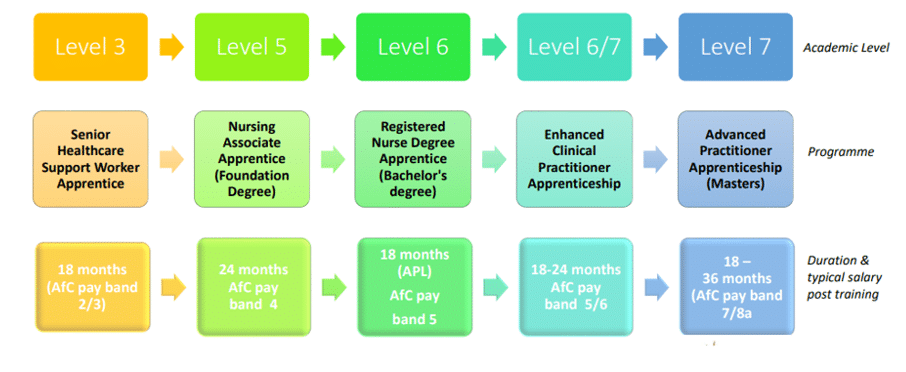
The illustration below shows how staff can be developed into senior roles:
What is the difference between a Registered Nurse and a Nursing Associate?
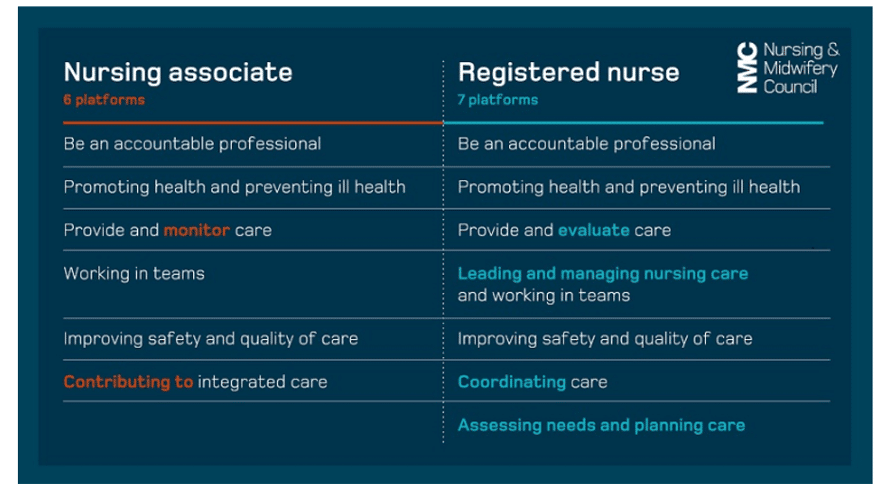
The Nursing and Midwifery Council (NMC) has summarised its standards for proficiency for both the registered nurse and nursing associate role in the table below:
We are currently waiting for an official national position statement regarding the nursing associate role, but as a guide we have nursing associates extending their roles in GP surgeries across BNSSG by undertaking cervical cytology samples, giving immunisations as part of the National Immunisation Programme under Patient Specific Directive.
The Royal College of Nursing is clear, based on the evidence, that Registered Nurses should not be substituted with Nursing Associates.
What does the Nursing Associate training involve?
The Student Nursing Associate (SNA)apprenticeship programme is a 2-year foundation degree at Level 5 and allows students to ‘learn while they earn’. It includes both academic and work-based learning and prepares trainees to work with people of all ages and in a variety of settings in health and social care.
The SNA programme consists of 2300 Hours over 2 years; 1150 theory and 1150 practice. 450 hours must be external (i.e. placements in different clinical settings).
If undertaking the apprenticeship at University of the West of England or University Centre Weston, placements are arranged by Placement Facilitators.
700 hours – should be Protected learning hours (Some practices give SNAs non-college days for this – i.e. those that fall in main university holidays – Christmas, Easter, Summer)
Protected Learning hours can include work that is undertaken anything s over and above their normal role):
Training days
Supervision
Working with other team members
(Pharmacists/ Pharmacy Technicians, ANP etc)
Visits to other areas – e.g. Milestones Trust (if working with LD patients), Unity etc.
Examples of how protected time within GP surgery can be used:
Performing an ECG – an HCA would perform an ECG, an extension of this for a SNA would be to reflect on the underlying pathology and suggested pathway for the patient if abnormality detected.
Identifying a diabetic foot ulcer during a diabetic foot check – an HCA would report this to a trained nurse for action, an extension of this for a SNA would be to consider micro/macular effects for the patient and potential issues if not reported.
What are the entry requirements to join the SNA apprenticeship programme?
To begin training as a Nursing Associate, Higher Education Institutes require evidence of the following qualifications.
Apprentices should be working a minimum of 30 hours per week to satisfy the apprenticeship rules.
Essential
GCSE grades 9 to 4 (A to C) in Maths and English OR Functional Skills Level 2 in Maths and English.
Level 3 Qualification (not necessarily in healthcare) – this is not required by all Higher Education Institutes.
Experience of working within a healthcare setting (minimum of 6 months).
Have lived in the UK for 3 years or more with the right to work and study in England with no restrictions. The right to live and work in the UK must cover the duration of the apprenticeship programme.
Disclosure and Barring service check within the previous 12 months (Universities will often complete a DBS check at the start of the apprenticeship).
To access placements in the acute settings trainees are required to undertake face to face manual handling training in order to participate fully.
What Universities run the SNA apprenticeship programme?
University of the West of England (UWE)
University Centre Weston
BPP
Provider
University of the West of England (UWE)
University Centre Weston
BPP
Entry Requirements
English and Maths (Level 2 Functional Skills/GCSE C/4 and above)
Level 3 Qualification (not necessarily in healthcare)
English and Maths (Level 2 Functional Skills/GCSE C/4 and above)
Exemption for level 3 (if the student is over 21 with a minimum of 3 years’ experience in healthcare – they request a short piece of writing summarising your intentions for the programme.
English and Maths (Level 2 Functional Skills/GCSE C/4 and above)
Level 3 Qualification (not necessarily in healthcare)
It is requested that practices offer reciprocal placements for other RNDAs working in other clinical areas to allow them to gain experience of primary care.
Practice requirements for supporting a SNA apprentice
The SNA apprentice should have a Practice Assessor within their practice who has completed relevant training.
It is requested that practices offer reciprocal placements for other SNAs working in other clinical areas to allow them to gain experience of primary care.
Step by Step guide to accessing the SNA apprenticeship (employer guide)
Step 1 – Assessing Workforce Needs
Determine whether to recruit an external candidate or develop an internal employee (a Healthcare Assistant) for the Student Nursing Associate (SNA) role.
Refer to Apprenticeship funding – GOV.UK , eligibility criteria and training commitments (individual training providers can give specific details). Applicant should have the right to work in the UK.
Applicant may require assistance gaining entry requirements; Maths and English courses can be accessed by various providers:
Applicants are required to attend face-to-face manual handling training and up to date with immunisations in order to be able to participate fully in external placements. (Refer to Immunisation Check list)
Ensure your practice/PCN has the necessary infrastructure, including a supportive nursing workforce (including a member of staff willing to become a Practice Assessor for the SNA trainee) and capacity to host an SNA.
Step 4 – Select a Training Provider
Chose a university that offers the SNA Apprenticeship, considering factors such as placement support and programme structure (see table below)
Step 5 – Eligibility Check
Verify that the candidate meets the apprenticeship criteria, including educational background (certificates will be provided by university) and right-to-work status.
Step 6 – Facilitate Candidate Application
Complete application for chosen university. UWE interview the candidate prior to application and will require an employer representative – this is usually a virtual interview. University Centre Weston and BPP request that an application form is completed first (see contact details on educational provider table).
Step 7 – Practice/PCN Levy Funding
Begin the process of securing levy funding for your candidate’s enrolment to ensure that the apprenticeship is fully funded. Individual universities can support with this.