Benefits of supporting a Nursing Associate to undertake the Registered Nurse Degree Apprenticeship
Statistics produced by the General Practice Workforce, 2025, suggest that 53% of the GPN workforce are over 50. It is essential that practices consider succession planning to ensure that high quality patient care continues. This model of “growing your own workforce” has been shown to improve retention.
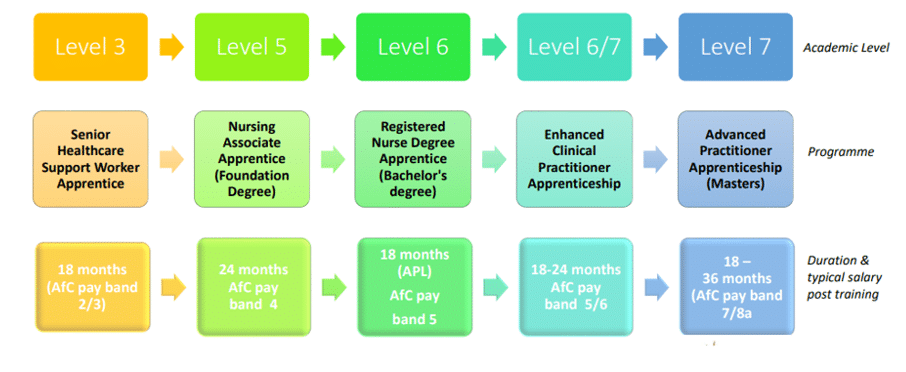
The illustration below shows how staff can be developed into senior roles:
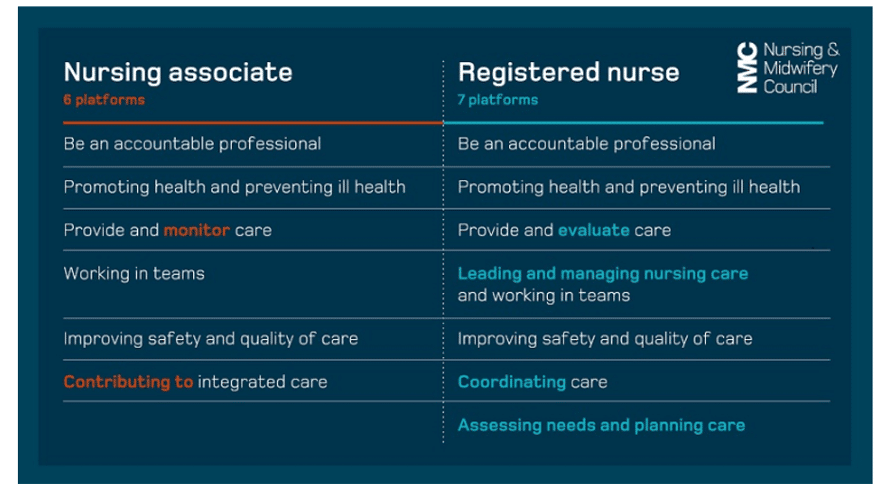
What is the difference between a Registered Nurse and a Nursing Associate?
The Nursing and Midwifery Council (NMC) has summarised its standards for proficiency for both the registered nurse and nursing associate role in the table below:
Nursing Associates are ideally placed to extend their skills by completing the Registered Nurse Degree Apprenticeship.
What does the Registered Nurse Degree Apprenticeship (RNDA) involve?
The RNDA is a 2-year programme, with 4 x 6-week placements over 2 years with a 2-week elective placement in year 2, with time spent in ‘base’ practice.
15 hours a week should be supernumerary. Activities could include training days, supervision, working with other team members (Pharmacists/ Pharmacy Technicians, ANP etc), visits to other areas – e.g. Milestones Trust (if working with LD patients), Unity etc.
An example of extending the scope of a Student Registered Nurse when supernumerary:
A Registered Nurse would carry out a full wound assessment (identifying wound type, grading and staging and assessing infection or deterioration); make clinical decisions on which treatments or dressings are appropriate; create, review and update the care plan, request medications; refer to tissue viability nurse; educate and supervise Nursing Associates performing delegated wound care; and take accountability for the overall outcome of wound management.
The Student Registered Nurse as an extension of their NA role could review work undertaken and reflect on next steps, ensure they are aware of the procedure for referring deteriorating patients etc.
What are the entry requirements to join the RNDA programme?
Institutes require evidence of the following qualifications.
Apprentices should be working a minimum of 30 hours per week to satisfy the apprenticeship rules.
Essential
GCSE grades 9 to 4 (A to C) in Maths and English OR Functional Skills Level 2 in Maths and English.
Completion of Nursing Associate training (foundation degree).
Completion of Assistant Practitioner course – additional modules (such as Medication management) will need to be undertaken alongside the RNDA programme (HEIs to advise).
Have lived in the UK for 3 years or more with the right to work and study in England with no restrictions. The right to live and work in the UK must cover the duration of the apprenticeship programme.
Disclosure and Barring service check within the previous 12 months (Universities will often complete a DBS check at the start of the apprenticeship).
To access placements in the acute settings trainees are required to undertake face to face manual handling training in order to participate fully.
Evidence of Immunisation status is also required to access external placements (see Immunisation Status checklist)
Course fees for the RND Apprenticeship are paid via an apprenticeship levy, as General Practices are non-levy paying, a levy transfer is utilised from larger organisations within BNSSG (e.g. NBT, UHBW).
Once a place on the RND apprenticeship has been secured, the Levy Transfer application form should be completed and sent to bnssg.workforce@nhs.net
To access these funds, practices are required to set up an Apprenticeship service account (if the practice has had apprentices before there is no need to do this).
Apprenticeship service Account – Digital Account Setup:
The RND apprenticeship programme does not currently attract a government payment to the employer as per the SNA apprenticeship. Practices can utilise the Additional Roles and Responsibilities Scheme to cover salaries.
It is requested that practices offer reciprocal placements for other RNDAs working in other clinical areas to allow them to gain experience of primary care.
Step by Step guide to accessing the RND apprenticeship (employer guide)
Step 1 – Assessing Workforce Needs
Determine whether to recruit an external candidate or develop an internal employee (a Nursing Associate or an Assistant Practitioner*) for the Registered Nurse role.
*NB. Assistant Practitioners (APs will need to complete additional modules such as medication management alongside the RNDA programme).
Ensure your practice/PCN has the necessary infrastructure, including a supportive nursing workforce (including a member of staff willing to become a Practice Assessor for the RND apprentice) and capacity to host a RNDA.
Step 4 – Select a Training Provider
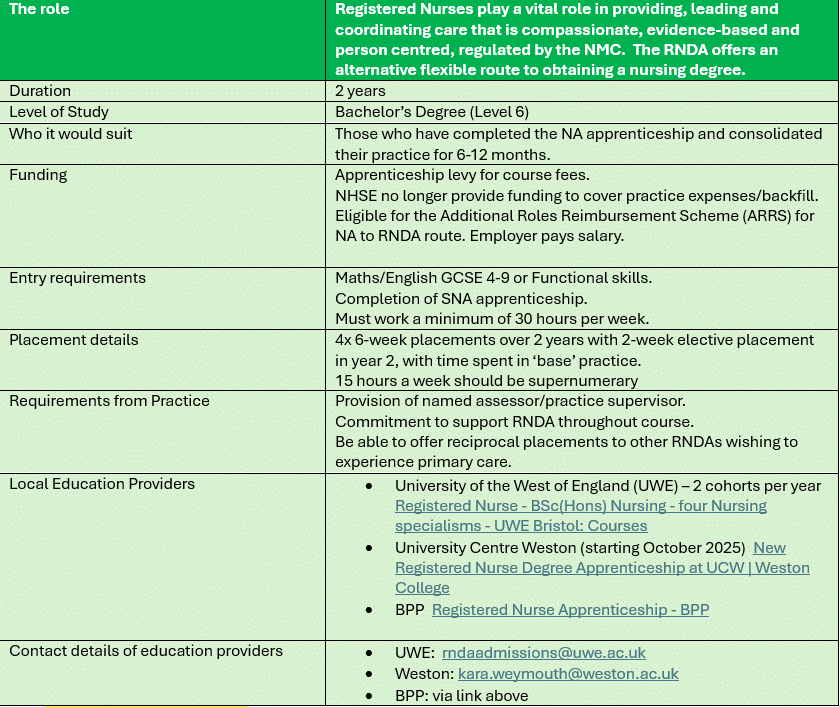
Chose a university that offers the RND Apprenticeship, considering factors such as placement support and programme structure (see table below)
Step 5 – Eligibility Check
Verify that the candidate meets the apprenticeship criteria, including educational background (certificates will be provided by university) and right-to-work status
Step 6 – Facilitate Candidate Application
Complete application for chosen university (see links on above table)
Step 7 – Practice/PCN Levy Funding
Begin the process of securing levy funding for your candidate’s enrolment to ensure that the apprenticeship is fully funded. Individual universities can support with this.